The Multifaceted Services LSPs Offer to the Video Gaming Industry
It goes without saying that game translation is more than just rendering the text to another language.
Game localization looks at the video game as a whole product to market it and make it appealing to other languages and regions. Localizing goes beyond literally interpreting the words, to adjusting the game’s material to the region’s culture and audience’s preferences.
More and more language service providers (LSPs) offer ‘mass’ localization and naturalization services for PC game publishers and programmers as the market becomes increasingly more sophisticated, competitive, and international.
This article highlights the importance of LSPs in helping game developers and publishers reach international markets and providing comprehensive localization services across various gaming platforms, as you will read below:
1. PC Game Translation
LSPs provide comprehensive translation services for various components of video games, including dialogue, menus, item descriptions, and tutorials. This process involves not just converting text from one language to another but also ensuring that the translation captures the tone, style, and intent of the original content.
For example, humor and puns may need to be adapted rather than directly translated to resonate with the target audience. Effective translation is crucial for player immersion, as any inconsistencies or awkward phrasing can disrupt the gaming experience and lead to player dissatisfaction.
2. Cultural Consulting
Cultural consulting is essential for ensuring that video games are relatable to the local audiences. LSPs provide insights into cultural norms, traditions, and values, allowing developers to create content that aligns with local expectations. Cultural consulting involves:
2.1. Understanding Local Restrictions
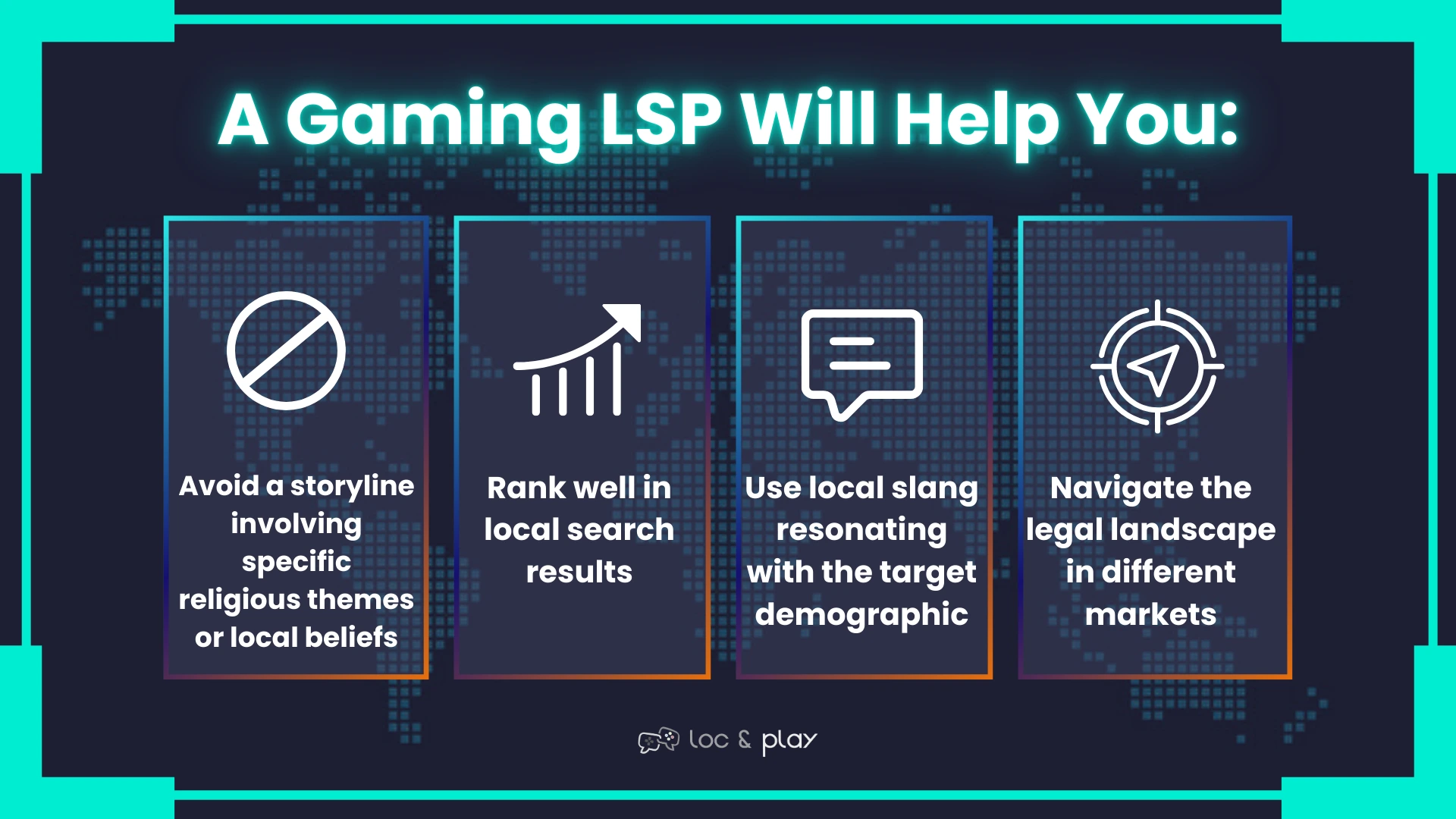
Different cultures have varying thresholds for humor, violence, and themes. LSPs analyze these critical issues, advising on content adjustments to avoid potential offense. For instance, a storyline involving specific religious themes may need careful handling or alteration to respect local beliefs.
2.2. Modifying Game Elements
Beyond storylines, cultural consulting can influence character designs, settings, and even gameplay mechanics. For example, visual symbols that are innocent in one culture may have negative meanings in another. Adapting these elements ensures a more welcoming experience for players.
3. Game Marketing and Community Management
LSPs enhance marketing strategies by localizing promotional materials for the game, and managing community interactions effectively:
3.1. Localized Game Marketing Campaigns
Translating and culturally adapting game advertisements, trailers, and social media content maximizes engagement. LSPs ensure that marketing messages are not only accurate but also appealing to local tastes. This could involve using local slang or references that resonate with the target demographic.
3.2. Engaging with the Community
Effective community management involves translating user-generated content, moderating forums, and responding to player inquiries in their native languages. LSPs help build strong relationships between developers and players, fostering a sense of community and loyalty. This interaction can also provide valuable feedback for future game improvements.
4. Linguistic Quality Assurance
Linguistic Quality Assurance (LQA) is a critical step in the game localization process, ensuring that the translated content functions correctly within the game. LSPs perform QA testing to identify linguistic errors and bugs that may arise from the game translation process.
This includes verifying that text fits within the game user interface without truncation and that all localized content displays correctly across different platforms. Playtesting is also a key component, as it allows native speakers to experience the game as intended, providing feedback on both the linguistic and gameplay aspects. Thorough QA helps maintain high standards and ensures that players receive a polished product.
5. Documentation and Support
Providing thorough documentation and support is crucial for enhancing the player experience:
5.1. Translating Game User Manuals and FAQs
LSPs translate comprehensive user manuals, guides, and FAQs, ensuring players can understand game mechanics and features. Clear instructions help players navigate the game more easily, reducing frustration and increasing enjoyment.
5.2. Customer Support in Local Languages
Offering customer support in gamers’ native languages is vital for addressing issues effectively. LSPs assist in translating support tickets, chat responses, and troubleshooting guides, making it easier for players to seek help and resolve problems. This service enhances player satisfaction and encourages positive perceptions of the brand.
6. Voiceover and Subtitling
Voiceover and subtitling services are essential for creating an immersive gaming experience. LSPs provide professional voice actors fluent in the target language to record character dialogues, ensuring that performances capture the emotional tone and personality of the characters. This process often includes directing the actors to maintain consistency with the original intention.
Subtitling, on the other hand, involves translating dialogues and displaying them on-screen, which is crucial for players who prefer reading or have hearing impairments. Effective subtitling must be concise while preserving meaning and timing with the spoken dialogue, enhancing accessibility and engagement for diverse player audiences.
7. Multilingual SEO Approach
Effective multilingual SEO strategies are necessary for increasing a game’s visibility across different markets. this includes:
7.1. Keyword Research and Optimization
LSPs conduct keyword research specific to each target language, identifying terms and phrases that potential players are likely to search for. This ensures that game-related content, including websites and promotional materials, ranks well in local search results.
7.2. Integrating Keywords into Game Content
Once relevant keywords are identified, LSPs incorporate them into game descriptions, website content, and promotional materials. This strategic placement helps improve search engine rankings, making it easier for players to discover the game.
8. LSPs and Game Adaptation
Game adaptation involves modifying various aspects of a game to better fit the cultural and market-specific needs of different audiences. LSPs provide valuable support in this area.
8.1. Modifying Game Elements
LSPs assist in adapting gameplay and content to align with local preferences. In some cases, gameplay mechanics may be modified to suit local gaming habits. For example, certain regions may favor competitive play, while others may prefer cooperative gaming experiences. LSPs provide insights to help developers make informed decisions.
8.2. Audio Adaptation
LSPs also help with adapting visual and audio elements to fit local markets.
8.3. Voiceover and Subtitling
Games may require new voiceovers or subtitles to cater to local languages. LSPs provide native speakers for voice acting, ensuring character portrayals are authentic and relatable. Subtitles must also be accurately translated to match spoken dialogue while maintaining timing and context.
8.4. Graphics and Symbols
Visual elements, such as icons or symbols used in the game, may need to be altered to fit local cultural contexts. LSPs help identify any graphics that could be misinterpreted or deemed inappropriate in certain regions
9. Conformity and Legal Services Offered by LSPs
Navigating the legal landscape in different markets is crucial for the successful distribution of video games. LSPs provide a range of compliance and legal services to support developers.
9.1. Understanding Local Regulations
LSPs help developers comprehend and comply with the various legal requirements specific to different countries. Different countries have unique regulations regarding age ratings and acceptable PC games content. LSPs assist in ensuring that the game meets these criteria, which is essential for a successful launch and to avoid legal challenges.
LSPs also provide guidance on game content restrictions, helping developers modify or remove elements that could violate local laws. This includes ensuring that the game aligns with cultural norms and societal expectations.
9.2. Translation of Legal Documents
Accurate translation of legal documents is critical for international business operations. LSPs translate contracts and agreements related to game development, distribution, and partnerships. Ensuring that all terms are clearly understood in the target language reduces the risk of disputes and misunderstandings.
Besides, LSPs offer services to help developers navigate intellectual property laws, ensuring that their content is protected against infringement in various regions. This includes translating patent applications and copyright registrations accurately.
A Final Word
As with other multimedia industries, LSPs play an important role to satisfy the prerequisites of video games and help them reach a global market. The Gaming Industry has always emphasized the importance of LSPs and appreciates their effort, as it enables the creation of video games that have an excellent international appeal. With the wider acceptance of gaming around the world, there is an increased demand for comprehensive localization to tailor the game’s features and marketing strategies to fit the particular region or country. LSPs serve an important purpose by allowing games to be marketed on a global scale.