How Translation and Localization Services Can Reshape the Global Video Gaming Experience
The video gaming business has evolved into a worldwide language in the present globalized world, enthralling viewers from a wide range of backgrounds and cultures. However, language boundaries present a major obstacle for game producers looking to engage gamers globally. Game translation services can help close this gap and provide smooth communication between players worldwide.
This article will explore how localization extends far beyond basic translation, encompassing cultural adaptation, user interface adjustments, voice acting, and more.
1. Breaking Language Barriers for Global Reach
Translation and localization enable video games to transcend linguistic borders. By providing accurate translations and adapting in-game content (dialogues, menus, instructions, subtitles), developers make their games accessible to players in diverse regions:
1.1. Making Games Understandable for Everyone
One of the primary ways translation and localization reshape the gaming experience is by eliminating language as a barrier. A great game might have outstanding gameplay mechanics, but if players can’t understand the instructions, dialogues, or objectives, they won’t be able to enjoy it fully.
Translation services ensure that menus, tutorials, dialogues, and on-screen texts are accurately rendered in the player’s native language. This makes the game accessible to non-English speaking markets, opening the door to millions of new players globally.
1.2. Expanding to Untapped Markets
Many regions, especially in Asia, the Middle East, Africa, and parts of Europe, represent emerging gaming markets. These areas often prefer or require content in their native languages. By translating games into languages like Arabic, Hindi, Turkish, or Polish, developers can tap into markets previously unreachable, thereby increasing downloads, subscriptions, and sales.
1.3. From Regional Hit to Global Phenomenon
Many successful games have grown from regional favorites to international blockbusters purely because of localization efforts. Games like Genshin Impact and PUBG Mobile became global hits largely thanks to their availability in multiple languages, illustrating how language inclusion drives worldwide adoption.
2. Creating Authentic Cultural Relevance
Localization goes beyond translation, it adapts cultural references, humor, idioms, character names, and even imagery to suit local preferences. For example, jokes or pop culture references that resonate in Japan might confuse players in Germany unless properly localized:
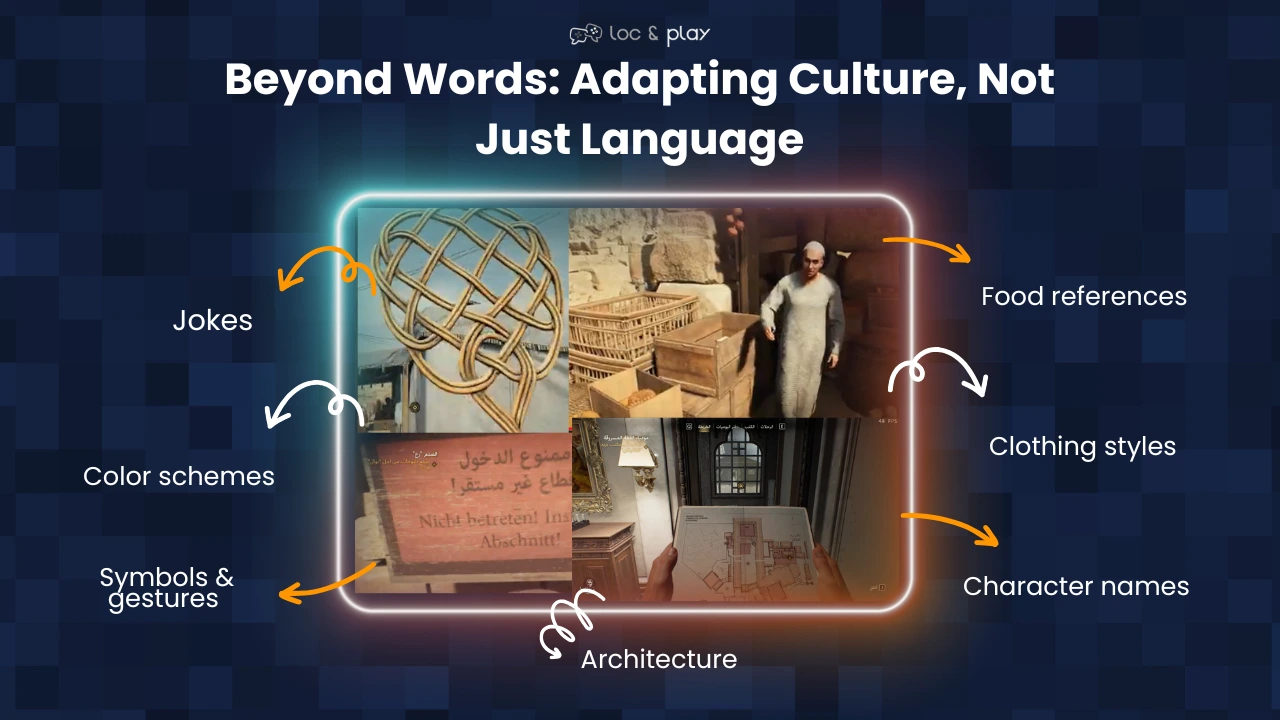
2.1. Beyond Words: Adapting Culture, Not Just Language
Localization is more than just translating words; it’s about adapting the entire gaming experience to the culture of the target audience. This means changing character names, clothing styles, architecture, food references, jokes, and even color schemes that may have cultural significance. For instance, certain symbols or gestures that are positive in one culture might be offensive in another.
2.2. Cultural Sensitivity Builds Trust
When players see that a game respects their traditions, humor, and lifestyle, they form a deeper connection with the experience. Localization experts ensure that sensitive topics are handled with care and that pop culture references are replaced with equivalents that resonate with local players. This builds brand trust and emotional loyalty, making players feel that the game was made specifically for them.
2.3. Examples of Successful Cultural Localization
Consider how Nintendo localizes its Animal Crossing series. In Japan, holidays like Setsubun are featured, while in Western versions, players enjoy events like Halloween or Christmas. This type of cultural adaptation allows the same game to feel native in different regions, enriching player engagement.
3. Boosting Player Immersion and Engagement
A fully localized game doesn’t just talk to players, it speaks with them. Translating voice acting (dubbing) and adapting storylines to regional tastes creates a world players can deeply connect with, as you will find here:
3.1. Immersion Begins with Language Familiarity
When a player interacts with a game in their native language, they can connect with the storyline and characters more deeply. Games that rely heavily on narrative (such as RPGs and adventure games) especially benefit from high-quality translation and voice dubbing, allowing players to feel like they’re part of the game world.
3.2. Localized Voice Acting Elevates Storytelling
A major factor in enhancing immersion is localized voice acting. Hearing characters speak in one’s native language with the correct emotional tone can completely transform how a story is perceived. It allows players to experience the game’s humor, drama, and suspense in a way that feels natural and impactful.
3.3. Higher Engagement, Longer Playtime
The more immersed a player feels, the longer they will spend in the game. Fully localized games consistently show better retention rates, with players more likely to complete storylines, participate in multiplayer events, and purchase downloadable content (DLC). This increased engagement also fuels fan communities, online forums, and social media discussions around the game, turning it into a shared cultural experience across regions.
4. Facilitating Cross-Cultural Multiplayer Experiences
In multiplayer and online gaming, players from around the world come together. Localization ensures that UI, chat functions, voice commands, and tutorials are understandable for all participants. This creates inclusive communities, reduces misunderstandings, and enhances cooperative gameplay in competitive e-sports, MMORPGs, and online shooters, as you can see here:
4.1. Creating Global Communities
Online multiplayer games are built around communities of players from around the world. Without localization, these communities risk fragmentation and miscommunication. By translating chat interfaces, menus, and instructions, developers create a unified global player base where individuals from different backgrounds can collaborate and compete seamlessly.
4.2. Supporting Cross-Region Play
Localization plays a critical role in enabling cross-region multiplayer functionality. Games that support multiple languages in their interface and communication tools help players overcome linguistic barriers, making international matchmaking smoother and more enjoyable. This strengthens online ecosystems, especially in genres like MMORPGs, battle royales, and esports titles.
4.3. Fostering International eSports Growth
For competitive multiplayer games, localization is essential for eSports development and tournament success. Commentary, tutorials, and rulebooks translated into various languages broaden participation and viewership. Successful eSports scenes in regions like Korea, Europe, and North America have thrived in part due to games that were fully localized and supported by international tournaments.
5. Enhancing Competitive Advantage for Developers
In today’s saturated gaming market, localization gives developers and publishers a clear edge. Games that are localized tend to outperform non-localized counterparts in sales and market penetration. Developers that invest in high-quality localization can enter new, emerging markets (like Latin America, Southeast Asia, and Eastern Europe) where the demand for localized content is rapidly growing.
6. Driving Higher Revenue and Monetization Opportunities
Localized games tend to generate higher revenue by reaching more players, encouraging in-game purchases, and fostering brand loyalty. Players are more likely to buy expansion packs, skins, or downloadable content (DLC) if they feel the game speaks directly to them. Additionally, localized advertising and promotions become more effective, allowing companies to maximize monetization.
A Final Word
A professional game localization business might be your best friend to unleash unheard-of growth and excite millions worldwide, whether you’re a major league decision-maker or an independent developer making your big break.