Breaking Language Barriers in Video Games: The Role of Translation, Localization, and Subtitling Services
Among the most common activities which might also be universal to all, at least for the vast majority of the population these days, is video gaming.
Video games are unstoppable through shared experiences, so now they are also a worldwide phenomenon that brings people from different races and countries together.
The major factor motivating this universal spread is called video game localization. A well-executed translation into regional languages can help generate revenue for game developers. It offers an immersive feeling that makes players from each country believe as if the game was designed specifically for them.
Here, we will discuss how LSPs help games reach broader audiences through adapting game elements to different languages and cultures.
1. The Importance of Language Services in PC Gaming
Video games have become a global phenomenon, transcending geographical and linguistic boundaries. To reach broader audiences and create immersive experiences for players worldwide, game developers rely heavily on translation, localization, and subtitling services. These language services play a crucial role in breaking down language barriers and adapting games to different cultures.
2. Translation: The Foundation of Language Accessibility
Translation forms the backbone of making video games accessible to international audiences. It involves converting the game’s text, dialogue, and user interface elements from the original language to target languages. Accurate translation is essential for preserving the game’s narrative, character personalities, and overall atmosphere.
Video game translation may encounter some challenges in:
- Preserving context dynamics.
- Adjusting metaphorical speech and cultural allegories.
- Dealing with space limits in user interfaces.
Effective game translation requires more than just literal word-for-word conversion. Translators must possess a deep understanding of both the source and target languages, as well as the game’s context and genre. They need to capture the intended tone, humor, and emotional impact of the original text while ensuring it resonates with the target audience.
3. Localization: Tailoring PC Games to Cultural Contexts
Localization goes beyond mere translation, encompassing the adaptation of a game’s content to suit the cultural norms, preferences, and expectations of specific target markets.
This process ensures that the game resonates with players in different regions and avoids potential cultural misunderstandings or offense.
Key Aspects of Game Localization:
- Adapting graphics, symbols, and color schemes.
- Modifying character designs and clothing.
- Adjusting gameplay mechanics to align with local gaming preferences.
- Localizing marketing materials and promotional content.
Cultural adaptation is a critical component of localization. It involves making changes to the game’s content, visuals, and design to ensure cultural appropriateness and appeal to the target audience.
This may include modifying character appearances, altering storylines, or adjusting in-game references to align with local customs and values. For example, developers might change food items in the game to reflect local cuisine or adjust character clothing to respect cultural norms. In some cases, entire gameplay mechanics might need to be reworked to suit the preferences of different markets. The goal is to create an experience that feels authentic and relatable to players in each target region.
4. Video Game Subtitling: Enhancing Accessibility and Immersion
Subtitling is a critical component of language services in video games, particularly for games with extensive voice acting or cinematic cutscenes. Well-executed subtitles not only make games accessible to deaf and hard-of-hearing players but also enhance the gaming experience for non-native speakers.
Best Practices in Game Subtitling
Any industry has its own standards. Accordingly, PC gaming does have their best practices:
- Synchronizing text with audio and visual cues.
- Using appropriate font sizes and colors for readability.
- Implementing options for subtitle customization.
- Considering screen space and positioning to avoid obstructing gameplay.
Effective subtitling requires careful consideration of timing, placement, and readability. Subtitles must be synchronized with the audio and visual elements of the game to ensure a seamless experience. This includes matching lip movements in cutscenes and accounting for the pacing of dialogue in gameplay.
Customization options for subtitles have become increasingly important. Many games now offer settings for font size, color, and background opacity, allowing players to adjust subtitles to their preferences and visual needs. This level of customization enhances accessibility and ensures that subtitles don’t interfere with the visual experience of the game.
In multiplayer games, real-time subtitling for voice chat can significantly improve communication and inclusivity. This technology allows players who are deaf, hard of hearing, or non-native speakers to participate fully in team-based gameplay and social interactions.
5. Voice-over and Dubbing in Video Games
Video game voice-over is an integral part of the game development process, significantly contributing to immersive, interactive experiences.
It involves using voice acting to bring game characters to life, narrate scenarios, and to provide player instructions. There are several types of voice over used in video games:
5.1. Character Voices
These require actors to portray a wide range of emotions and reactions, delivering believable performances that enhance character development and story progression.
5.2. Narration
A narrator’s voice can guide the story. It introduces characters and settings, provides background information and lore, bridges gaps between gameplay sections, and, overall, sets the tone and atmosphere of the game
5.3. Instructional Voiceover
These voices guide players through game mechanics, provide real-time feedback during gameplay, and offer tips and hints to players; thus they must be clear, concise, and easy to understand.
5.4. Environmental Voiceover
These bring the game’s world to life, including ambient sounds and background conversations. The process of selecting the right voice for a video game character involves considering factors such as matching the character’s personality, age, and background.
Besides that, AI dubbing is emerging as a significant trend in video game voice-overs. It uses artificial intelligence to automatically generate and synchronize voice-overs for in-game characters.
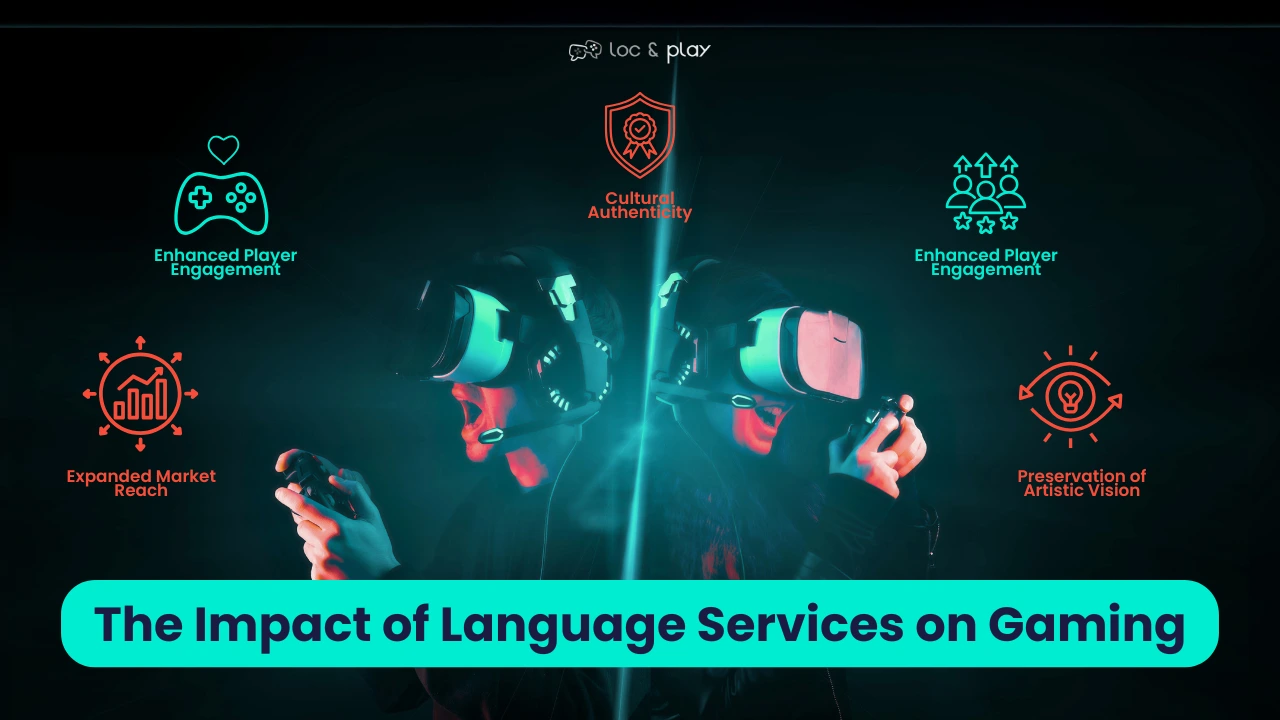
6. The Impact of Language Services on Gaming Experiences
The implementation of high-quality language services has a profound impact on gaming experiences, significantly enhancing player engagement and satisfaction across global markets.
These services enable players to fully immerse themselves in the game’s narrative, understand complex gameplay mechanics, and connect with characters on a deeper level:
6.1. Enhanced Player Engagement
Well-localized games allow players to engage with the content in their native language, leading to a more immersive and enjoyable experience. This increased engagement can result in longer playtimes, higher player retention rates, and more positive reviews.
6.2. Expanded Market Reach
Producing games in multiple languages allows developers to penetrate new markets and reach a broader audience. This expansion not only increases potential revenue but also contributes to the global gaming community’s diversity.
6.3. Cultural Authenticity
Proper localization and cultural adaptation ensure that games feel authentic to players in different regions. This authenticity builds trust and appreciation among players, fostering a stronger connection between the game and its audience.
6.4. Improved Accessibility
Language services, particularly subtitling and audio localization, make games more accessible to players with hearing impairments or those who prefer to play in their native language. This inclusivity broadens the game’s appeal and aligns with the industry’s growing focus on accessibility.
6.5. Preservation of Artistic Vision
Skilled translators and localizers work to preserve the original game’s artistic vision while adapting it for new markets. This delicate balance ensures that the core essence of the game remains intact across different languages and cultures.
7. Technological Advancements in Game Language Services
The field of game language services continues to evolve with technological advancements. Machine translation and artificial intelligence are increasingly being used to streamline the translation process, although human expertise remains crucial for ensuring accuracy and cultural sensitivity.
Emerging Technologies in Game Language Services:
- Neural machine translation for initial drafts.
- Translation memory tools for consistency across game updates.
- Cloud-based collaboration platforms for global localization teams.
- Automated quality assurance tools for detecting linguistic issues.
8. Challenges and Future Directions
Despite significant progress, the gaming industry still faces challenges in providing seamless language services across all titles and platforms. Indie developers, in particular, may struggle with the costs associated with comprehensive localization efforts.
Future Trends in Game Language Services:
- Increased focus on culturalization beyond basic localization.
- Integration of real-time translation features in online multiplayer games.
- Development of more sophisticated voice recognition and text-to-speech technologies.
- Greater emphasis on inclusive language and representation in game adaptations.
A Final Word
The international success of a video game depends on a superior-quality translation, subtitling, localization, and voice-over. A video game with quality localization will attract a larger gamer segment, and more game downloads, eventually generating more sales and profits. To the contrary, a game with low-quality localization will render the PC game boring and the player will lose the captivating atmosphere.