How Game Translation and Localization Drive Global Revenue and Player Engagement
Many businesses still think that simply translating in-game content from one language to another is sufficient and confuse game localization with basic text translation. This misunderstanding frequently results in mediocre localization outcomes, which in turn contribute to bad player experiences, unfavorable publicity, and eventually, financial failure in new regions. Professional game localization is actually much deeper.
This article explores the substantial financial impact of translation and localization, highlighting how so much of video game revenue comes from non-English speaking markets.
1. Expanded Gaming Market Reach and Revenue Growth
Localization expands market reach, increasing revenue by catering to diverse languages and regions, especially in Asia-Pacific where most of global gaming revenue is generated:
1.1. Access to New Gaming Markets
Localization allows games to penetrate global markets by breaking language barriers. English may dominate in North America and parts of Europe, but in China, Mandarin is essential, especially since it’s the world’s largest gaming market by revenue. In Latin America, Spanish and Portuguese (for Brazil) are crucial. In Germany, France, Japan, and South Korea, players overwhelmingly prefer native-language games.
When marketers and localizers put in mind these audiences, they can tap into new customer segments, increasing download and purchase rates, in addition to stronger brand presence.
1.2. Increased Sales and Return on Investment (ROI)
Localized games have shown up to 50% or more increases in revenue in targeted regions. This comes from higher conversion rates (players are more likely to buy if they understand the language), more DLC and in-game purchase opportunities (players engage more deeply when they comprehend the story and gameplay), besides the long-term monetization as players in localized markets are more likely to continue spending over time.
2. Enhanced Player Engagement and Retention
Effective localization enhances player immersion and satisfaction, leading to higher player engagement and retention rates as players connect more deeply with culturally adapted content:
2.1. Immersive Experience Through Cultural Adaptation
Localization isn’t just about words and sentences, it’s about culturalization—adjusting jokes, character names, pop culture references, colors, symbols, and holidays to fit local tastes. Moreover, making sure the voice acting, soundtrack, and even body language fit the cultural expectations of the audience.
This leads to a seamless and immersive experience, where players feel the game was made specifically for them, and more emotional investment, which increases loyalty and session duration.
2.2. Better Comprehension = Better Gameplay
Misunderstood UI, unclear instructions, or mistranslated storylines can frustrate players. Localization improves tutorial clarity, and thus helping new players ramp up quickly. Objective clarity, so players don’t quit due to confusion. Additionally, onboarding success, especially in complex games like Role-Playing Games (RPGs) or Massively Multiplayer Online (MMOs) is essential.
A clear, native-language experience boosts player retention, which is essential for subscription-based or free-to-play models.
3. Positive Gaming Community and Word-of-Mouth
Clever localization fosters a positive community by providing inclusive experiences, encouraging word-of-mouth referrals and community building around games that resonate culturally:
3.1. Localized Community Building
Games thrive on their communities. Localization supports localized chat rooms, forums, and Discord servers, allowing players to connect more meaningfully. There is also customer support rendered in the player’s language, resolving issues faster and increasing trust. And finally, the localized social media content, which boosts engagement and shares.
This creates strong fanbases that produce user-generated content (memes, fan art, mods) in their own languages, as well as becoming advocates for the game in their regions, organically growing the player base.
3.2. Cultural Sensitivity Avoids Backlash
Poorly localized games can cause unintentional offense (e.g., using religious or political symbols incorrectly), censorship issues in countries like China or the Middle East, in addition to social media backlash that damages brand reputation.
Clever localization involves cultural consultation and testing, which helps build trust and goodwill. It also prevents PR predicaments that could cost millions in lost sales and rework.
4. Strategic and Competitive Advantage
If programmers offer a successfully localized content, they gain a competitive edge over non-localized games, especially in competitive markets like Asia where localized games dominate sales:
4.1. Harness the First Mover Advantage
Entering a region with localized content before competitors can establish market dominance early on and build loyal communities that are harder for newcomers to sway. Additionally, this creates strong local brand identity that endures across game titles.
Therefore, smaller studios that localize early can outmaneuver big names that ignore regional players.
4.2. Data-Driven Optimization
Localized versions of games can feedback valuable regional analytics, such as what content types resonate most (e.g., narrative vs. combat), spending habits in different cultures, time played per session, session frequency, and abandonment points.
This data can be used to improve updates and patches tailored to specific regions, as well as informing local marketing campaigns. This can also guide development of future games based on localized player feedback.
5. Higher App Store and Platform Visibility
Games with multiple languages often appear more prominently on app stores, increasing visibility and attracting more players from diverse regions:
5.1. Localized Store Listings Drive Discoverability
When game developers localize not just the in-game content but also their app store metadata, they significantly improve their visibility, because localized titles and descriptions help games appear in local language searches. App Store Optimization (ASO) benefits from regional keywords, increasing the chances that players in different countries will discover the game. Screenshots and trailers adapted to the language and preferences of local audiences are more compelling and increase conversion rates (store views to downloads).
For example, a Japanese player is far more likely to download a game that has a Japanese title and description than one with only English text. Platforms like Google Play and Apple App Store allow per-language asset customization, which makes localization a competitive advantage.
5.2. Increased Chances of Being Featured
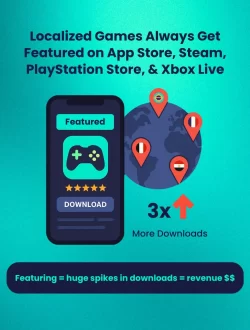
Digital storefronts like the App Store, Steam, PlayStation Store, and Xbox Live often prioritize localized games when selecting regional features (Featuring = huge spikes in downloads and revenue). Some stores have editorial teams in each country who specifically look for high-quality, well-localized content.
In short, the more localized your game, the more visible and attractive it becomes to both platforms and players.
Digital storefronts like the App Store, Steam, PlayStation Store, and Xbox Live often prioritize localized games when selecting regional features (Featuring = huge spikes in downloads and revenue). Some stores have editorial teams in each country who specifically look for high-quality, well-localized content.
In short, the more localized your game, the more visible and attractive it becomes to both platforms and players.
6. Better Monetization of In-App Purchases (IAPs)
Localization improves in-game purchase conversion rates as players are more likely to spend money on content that feels native and culturally relevant:
6.1. Localized Pricing Boosts Conversions
Games with in-game stores benefit greatly from local currencies (e.g., yen, pesos, rupees), region-appropriate price tiers based on local purchasing power. There are also discounts or bundles tailored to local holidays and cultural events (e.g., Ramadan packs, Golden Week sales, Black Friday).
These factors contribute to higher average transaction values, increased frequency of microtransactions, and players being more likely to make purchases if they feel the offers are made for them, not imported from elsewhere.
6.2. Language + Payment Methods = Trust
A critical but often overlooked factor is trust. If players don’t fully understand the item descriptions, pricing, or checkout process, they’ll abandon the purchase. Localized interfaces and support for local payment options (like Boleto Bancário in Brazil or AliPay in China) remove barriers.
This leads to reduced cart abandonment, as well as higher customer satisfaction and retention.
7. Easier Alignment with Local Game Content Regulations
Localization helps comply with local content regulations, reducing legal risks and ensuring smoother market entry by adapting to regional standards:
7.1. Censorship and Content Regulations
Many countries enforce strict rules on what content can or cannot appear in video games. Without localization, games risk being banned or rejected from stores, and developers might face fines or legal action for non-compliance.
Proper localization includes replacing or removing sensitive imagery (e.g., skeletons in China, gambling references in certain markets); adapting dialogue, themes, and visuals to align with local cultural and legal standards; and adjusting for local rating systems like PEGI (Europe), ESRB (North America), or CERO (Japan).
7.2. Legal Texts and Data Privacy Conformity
Games must often include localized End-User License Agreements (EULAs); privacy policies in line with laws such as GDPR (EU), COPPA (US), or LGPD (Brazil); and, additionally, clear, legally compliant consent forms for data collection.
When users can read and understand these documents in their native language, it builds brand trust, ensures regulatory approval, and protects the publisher from lawsuits or data violations.
Examples of Successful Localization
Successful game localization has played a key role in the global dominance of titles like League of Legends, The Witcher, and Pokémon:
League of Legends by Riot Games is localized into over 20 languages, featuring region-specific voiceovers, cultural references, and even unique in-game events, helping it build massive player bases in markets like Korea, Brazil, and China.
The Witcher series, developed by CD Projekt Red, saw worldwide success through high-quality translations and fully voiced dialogues in multiple languages, including exceptional attention to cultural intricacies.
Nintendo’s Pokémon franchise exemplifies localization excellence. Its character names, dialogue, and humor are carefully adapted to suit different regions, making it universally appealing without losing its original charm.
These examples show that localization isn’t just about translation, it’s about tailoring the entire gaming experience, which drives global engagement, builds loyal communities, and unlocks massive revenue potential across diverse markets.
A Final Word
Game translation and localization are not optional, they’re strategic growth levers. They open new revenue streams, deepen player engagement, and strengthen brand equity on a global scale. For studios aiming to scale, especially in today’s globalized gaming ecosystem, investing in robust localization is not just smart… it’s essential.